Phase 1: The AI Quick Start
I get it! You are a small business owner, a newly aspirational entrepreneur. You have ideas and passion, a small budget, and you need to build a website to get started.
Honestly, if I were in that situation today and not a web designer, I might lean on AI too. Claude will spit out a lovely landing page in HTML in seconds, and you can put it up online.
This phase is all about speed. AI gives new founders a starting point, and I am not here to talk you out of it.
But Then Phase 2 Hits
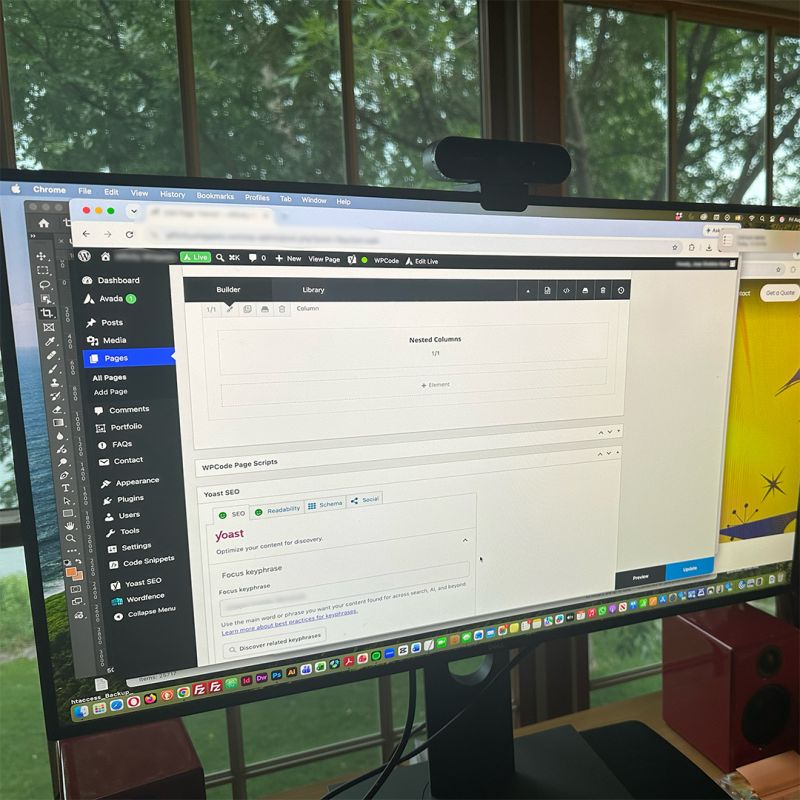
I built a landing page with Claude recently. It looked good, I genuinely liked it. But I still rebuilt and refined it in WordPress.
Even with a strong AI layout, it takes human brand design to give a site true identity, polished aesthetics, and strategic positioning. AI can generate a quick layout, but a real designer creates the brand experience.
Plus, the client needed a CMS to edit content freely, and I needed an efficient setup to handle accessibility, schema, security, and long-term SEO.
Generating a fast layout is Phase 1. Designing a brand experience that actually scales and converts is Phase 2.
Eventually, a business grows past the DIY stage, and non-technical owners hit the Phase 1 wall:
- Raw AI code breaks or becomes impossible to update without technical know-how.
- Standard prompts stop yielding exact, custom design needs.
- Critical foundations like ADA compliance, technical SEO, and GEO (Generative Engine Optimization to be found in AI search) get missed completely or fall short of the strategy needed to drive real ROI.
AI can generate raw output, but it does not possess strategic accountability, technical compliance expertise, or true brand design vision.
The Real Power: Human + AI Partnership
None of this is really new. For years, people have rushed to DIY builders like Wix and Squarespace and templates to get a quick start, only to find the text flying off the screen and the SEO strategy missing.
People have been coming to me for the Phase 2 website that actually works for a long time.
Phase 2 to me also means building leaner AI. We can use Small Language Models (SLMs) and local edge processing so simple tasks get handled efficiently, using a fraction of the energy of large data centers.
So, the summary: this is a new landscape, but to me, a familiar pattern. AI will improve what it does, but it’s the marriage of AI to human strategy and oversight, beautiful design, inclusion for all people, and the ROI delivered at the necessary levels for financial growth, that is what is delivered by Phase 2.
We walk hand in hand with technology, choosing the right tool for the task rather than the biggest one, to get the best outcomes for our clients.
Where do you draw the line between Phase 1 quick starts and Phase 2 long-term strategy in your own workflow?